Mostrando entradas con la etiqueta Haití. Mostrar todas las entradas

jueves, 2 de febrero de 2023

Marlène Dorcena - Mèsy


Nacida en Haití, Marlène Dorcéna creció en el sur, en Les Cayes. En la escuela practicaba un repertorio de canciones francesas y también cantaba gospel en el coro de la iglesia local. Tras el golpe de Estado de 1991 en Haití, decidió instalarse en Bélgica para continuar sus estudios de Periodismo y Medios de Comunicación. Aquí conoce a Raoul Nassar ( música, compositora y médica haitiana) que la incita a desarrollar un vasto repertorio de canciones tradicionales, así como composiciones propias sobre las inquietudes de la vida cotidiana y la lucha por un Haití mejor. En su primer CD “Mèsy” da a conocer la alma, colores, risas y poesía de la gente de su isla. Su país natal simboliza el sol, el turismo y la “criollidad”, pero también es una de las regiones más pobres del mundo. En Haití, la gente canta para luchar contra la desesperación de las condiciones de vida insoportables, cantan con fuerza y la convicción de que cantar al sol les ayudará a olvidar su miseria. Desde hace varios años, junto a destacados músicos, Marlene presenta y comparte su país y su cultura con numerosos públicos. El compromiso de Marlène no se limita a ella tiempo pasado en el escenario. Las condiciones y cargas de las mujeres y los niños de su país la preocupan profundamente… (proyecto de abastecimiento de agua potable en un pueblo de Haití). Colabora con asociaciones como Broederlijk Delen, Amnistía Internacional, 11.11.11 y anima talleres de teatro para niños. En su nuevo disco “Haïti”, sin cambiar de estilo, Marlène busca nuevos sonidos, nuevas emociones sencillas producidas con instrumentos hechos de madera natural. componentes como el lambi (instrumento utilizado por los haitianos durante la revolución),  tambor haitiano


1 Papadanmbalah (Papa Damballah)
2 3 Fey
3 Mize Pas Dous, La
4 Papa Loko
5 Mesy Bondye
6 Malere
7 Lanmou Lakay
8 Fanmy, La
9 Panama
10 YoYo
11 Wangol


sábado, 25 de julio de 2015

Chouk Bwa LIbète – Se Nou Ki La


Chouk Bwa Libète is a Haitian mizik rasin (root music) band deeply embedded in rural voodoo and its three ingredients, drums, songs and dance. This economy of means proves all the more powerful to express the intensity of their mystical, committed discourse. This debut album was made in April 2014 in the village Petite Rivière Bayonnais, close to the lakou of Souvenance where the drum-maker Charles Simé lives. Recorded under the cover of an ajoupa open to the winds, these 15 tracks bear the marks of daily village life and carry the flame of a cosmopolitan African inheritance. The CD booklet features photos by Jacques-Yves Le Docte and excerpts from Yanick Lahens’ novel Bain de Lune, as a subtle and brotherly reflection to Jean-Claude ‘Sambaton’ Dorvil’s mighty lyrics (fully featured in the liner notes).http://www.rfimusique.com/actu-musique/musiques-monde/album/20150513-chouk-bwa-libete-haiti


1 Apèl lanbi
2 Idantifikasyon
3 Moun yo plae
4 Pran ka M nago
5 Veronese chante
6 Jimo marasa
7 Kouzen zaka
8 Makout lenba
9 Azouke
10 Olicha legba
11 Je M la
12 Kwè nan bondye
13 Lapriyè
14 Pawol jatibwa
15 Nèg ayisyen

martes, 23 de junio de 2015

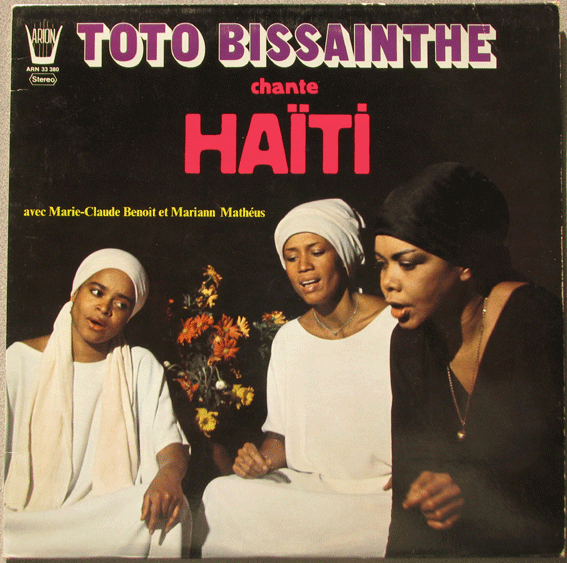
Toto Bissainthe - Chante Haiti (1977)


Marie Clotilde "Toto" Bissainthe (1934 – June 4, 1994) was a Haitian actress and singer known for her innovative blend of traditional Vodou and rural themes and music with contemporary lyricism and arrangements. Born in Cap-Haïtien in 1934, she left Haïti at an early age to pursue her studies abroad. Her career started in theatre with the company Griots, of which she was a founding member in 1956. Griots was at the vanguard of négritude-inspired cultural institutions in France, and was the first African theatre company in Paris.

With a groundbreaking performance in 1973 at La vieille grille in Paris, Toto Bissainthe established herself as singer-songwriter-composer, stunning the audience with her soul-stirring renditions of original compositions that paid homage to the lives, struggles, miseries and spirituality of working class and rural Haïtians.

An artist in exile, Toto Bissainthe will be unable to return to the Haïti that so inspired her until the departure of Jean-Claude Duvalier in 1986. However, the multiple disappointments of the unending democratic transition and political infighting would forever embitter the outspoken artist, who had long dreamed of a return to help rebuild her motherland. Saddened by Haïti's social and political degradation, Toto Bissainthe's health would enter a downward spiral ending with her death from liver damage on June 4, 1994.https://en.wikipedia.org/wiki/Toto_Bissainthe

Bass – Beb Guérin
Guitar – Patrice Cinélu
Percussion – Akonio Dolo, Mino Cinélu
Vocals – Mariann Mathéus, Marie-Claude Benoit, Toto Bissainthe


1 Soley Danmbalab
2 Papaloko
3 Ibo Ogoun
4 Papa Danmbalah
5 Lamize Pa Dous
6 Dey
7 Rasanbleman

martes, 10 de febrero de 2015

Boulpik -Konpa Lakay


‘Chèche lavi.’ Seek living. A two-word expression in Haitian Creole that sums up the phrase ‘Seeking ways of earning a living’ and suggests that a living is not something that comes easily, but a goal to be sought - as if you were on a quest for a lost prize or buried treasure. So Franckel Sifranc and his fellow musicians in Boulpik are seekers of life. Nothing particularly extraordinary has happened in their careers. In fact, their past is very like that of millions of other Haitians - except that they have a gift for music.

Franckel’s story began around fifty years ago in La Grand Anse, the Republic of Haiti’s most remote region, far to the west. Thinking back to his childhood in the coastal village of Dame-Marie, he remembers the sounds of the ‘ti djaz’ (little jazz): acoustic bands of amateur musicians who were so called to distinguish them from the more prestigious ‘gwo djaz’ (big jazz) bands with their modern instruments and amplifiers. The ti djaz playing at provincial gatherings used rudimentary, often locally-made instruments: a six-string “Matamò” guitar (its name a reminder of the Trio Matamoros’s strong influence on the genre), a trè (a guitar of Cuban origin with three strings, sometimes doubled) or even a banjo. The instrumental line-up was completed by a three-string double bass or a maniboula (a plucked idiophone based on the Cuban marímbula) and percussion: a drum, maracas and scraping board or kaskayèt (claves) to accompany the vocal chorus that responded to the main singer.+INFO


01. Alakanpay (4:00)
02. Boulpik Twoubadou (4:14)
03. Si Lavi Te Fasil (3:33)
04. Nèg Dafrik (3:59)
05. Karol (4:41)
06. Lakay (5:09)
07. Rele (4:42)
08. Jeremie (4:25)
09. Twa Zan (4:04)
10. Je reviens chez nous (3:41)
11. Souvenir d’Afrique (3:50)
12. Lavi a Di (3:36)


viernes, 16 de enero de 2015

Melissa Laveaux - Camphor and Copper


Mélissa Michelle Marjolec Laveaux (born 9 January 1985) is a Canadian singer-songwriter and guitarist of Haitian descent signed to No Format!. Her music has been described as a mix of roots, folk, and blues using her signature percussive finger-style guitar and soulful vocal stylings. In 2006, Laveaux released a first full-length album of her own songs. It was co-produced with percussionist Rob Reid (on tabla and cajón) and Lisa Patterson of Imaginit Music Studios.Laveaux has received critical praise from her peers in such magazines as Colorlines and is a Songs from the Heart recipient from the 2006 Ontario Council of Folk Festivals' conference in the World Music category for penning "Koud'lo".

Mélissa has opened for several artists who have inspired her music: Meshell Ndegeocello, Feist and Lura. She's also performed at jazz and popular music festivals around the globe. Although most of her performances have been in France, she regularly performs in Japan and Spain. Festivals that have featured Laveaux include the Montreal International Jazz Festival (2007, 2009 and 2010), Cully Jazz, Donostia Jazzaldia, Festival du Bout du Monde (2008), Les Francofolies de La Rochelle (2009), Sakifo Musik Festival in La Réunion Island and le Printemps de Bourges. She has been a featured guest on CBC Radio's local programs Ottawa Morning and All in a Day and its national radio broadcasts Bandwidth, Canada Live, and Go!.

http://en.wikipedia.org/wiki/M%C3%A9lissa_Laveaux


01 - Scissors
02 - My Boat
03 - Chère Trahison
04 - Ulysses
05 - Interlude Haïti
06 - Koudlo
07 - Dodo Titit
08 - Needle In The Hay
09 - Interlude Voyeur
10 - Games Of Unrest
11 - Akeelah'S Heel
12 - I Want To Be Evil
13 - Les Cendres (bonus tracks)
14 - First Class (bonus tracks)

jueves, 15 de marzo de 2012

VV. AA. - En Clave AfroCaribe

Subido por Guayacas


En Clave AfroCaribe reúne en este disco las expresiones más representativas de la música generada por la diáspora africana en la costa caribeña de Centroamérica (Belice, Guatemala, Honduras, Nicaragua, Costa Rica y Panamá), República Dominicana y Haití. Calipsos y bullerengues; salves y palos; parrandas y puntas; ritmos y cantos que emergen desde lo más profundo de la antigua espiritualidad africana, reinventada en la región Caribe. Orishas, santos, espíritus y ancestros cantan y bailan al ritmo de los tambores en las voces y en los cuerpos de los músicos presentes en estas grabaciones.
Este disco forma parte del proyecto En Clave AfroCaribe, cuyo objetivo es visibilizar las ricas y diversas expresiones musicales afrodescendientes de la costa Caribe, a través del estudio, recuperación y difusión de sus diferentes ritmos.
Un proyecto de la Agencia Española de Cooperación Internacional para el Desarrollo (AECID), realizado en red por los Centros Culturales de España en Guatemala, Honduras, Nicaragua, Costa Rica y República Dominicana.
Pistas:
01 - Segundo (clypso limonense) COSTA RICA
02 - Fire in the land with the Lobster Band (calypso limonense) COSTA RICA
03 - Reinado de San Miguel (palos) REPÚBLICA DOMINICANA
04 - Virgen de los Dolores (salve) REPÚBLICA DOMINICANA
05 - Sensu Tioü Balebei - Wabala Buguchi HONDURAS
06 - Busiñe waulla - Lebuga wellu (wanaragua) HONDURAS
07 - Africa (reggae fusión) NICARAGUA
08 - Mango Ghost (palo de mayo) NICARAGUA
09 - Rytme Mahi (canción tradicional) HAITÍ
10 - Dilere (yaya ti Kongo) HAITÍ
11 - A ti nada más (cumbia Congo) PANAMÁ
12 - Pile (bullerengue tradicional) PANAMÁ
13 - Hattie (parranda) BELICE
14 - Pressure (dub) BELICE
15 - Vinu niguirayali (parranda) GUATEMALA
16 - Came Beyedana (punta) GUATEMALA

Enlace


EN CLAVE AFROCARIBE
Contraseña (pass): musicmund
mp3 a 320 kbps + portadas y folleto completo